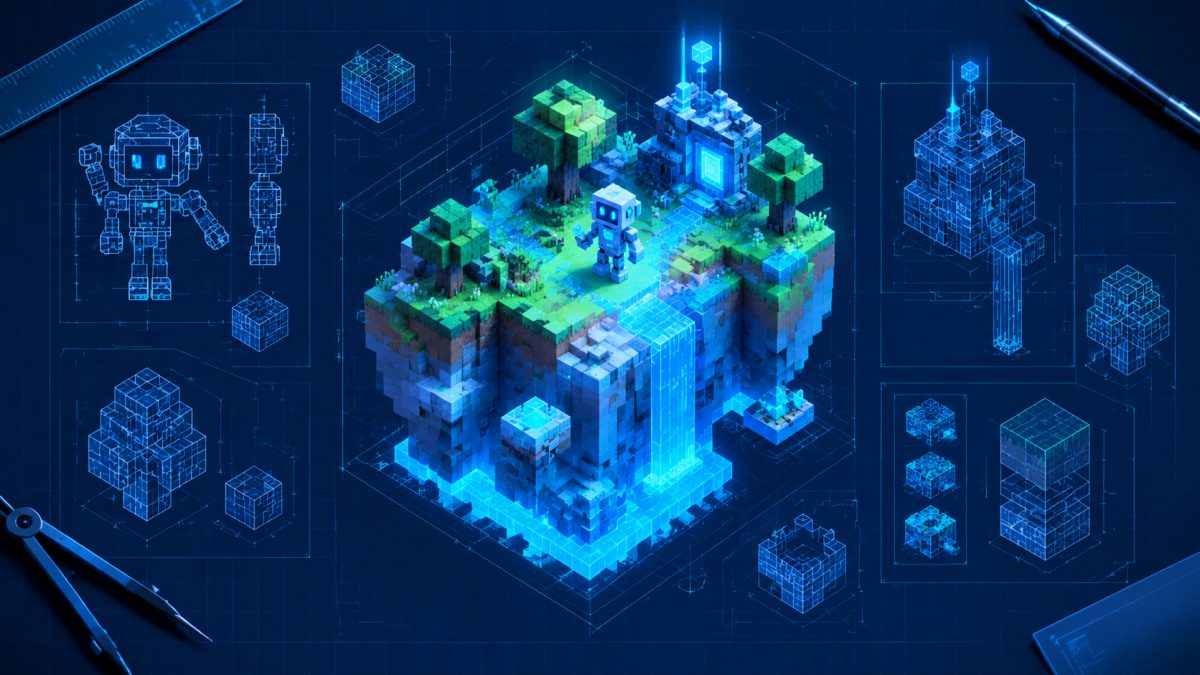
The Metaverse Dream Fades, But Its Infrastructure Finds New Life
The grand vision of humans living inside persistent virtual worlds has largely collapsed. Meta has quietly pivoted away from its metaverse branding, consumer VR headset sales have plateaued, and the token-based virtual land boom of 2021 has turned to dust. Yet the digital scaffolding built for that imagined future — spatial mapping engines, real-time simulation environments, low-latency edge networks, and decentralized compute layers — has not gone to waste. It is being repurposed for a different kind of inhabitant: robots.
From Avatar to Automaton
The core technologies that powered virtual worlds are proving remarkably transferable to physical robotics. Spatial computing stacks developed for VR headsets now feed directly into robot perception systems. Reinforcement learning environments originally designed to train virtual agents are being used to train robotic arms and autonomous mobile robots. Even blockchain-based identity and payment rails, built for virtual avatars, are finding use cases in machine-to-machine coordination — allowing fleets of robots to authenticate, transact, and settle payments on-chain without human intervention.
This convergence is attracting serious capital. Robotics startups are increasingly leaning on simulation-first development pipelines, where robots are trained in photorealistic digital twins before being deployed in the physical world. The same GPU clusters that rendered virtual worlds are now rendering training environments for embodied AI. Decentralized physical infrastructure networks (DePIN) are emerging as a way to crowdsource sensor data and compute for robotics, creating a crypto-native feedback loop between virtual training and real-world action.
Why Crypto Rails Matter for Robot Economies
As robots become more autonomous, they need economic agency. A delivery robot must pay for charging, maintenance, and right-of-way. A warehouse robot may need to purchase compute from a decentralized network on demand. Stablecoins and smart contracts offer a programmable settlement layer that traditional banking cannot match for high-frequency, low-value machine transactions. Several projects are already experimenting with robot wallets and on-chain service-level agreements, positioning blockchain as the coordination layer for a machine economy.
The Road Ahead: From Hype to Hardware
The pivot from metaverse to robotics is not a retreat — it is a maturation. The speculative excess of virtual land and avatar fashion has given way to tangible applications in logistics, manufacturing, agriculture, and healthcare. The infrastructure built during the metaverse boom — decentralized compute, spatial data networks, digital identity protocols — is now being stress-tested by real-world constraints. Investors and builders who survived the metaverse winter are finding that the most valuable virtual world may be the one that robots inhabit to learn how to operate in ours.
- Key takeaway: Metaverse infrastructure is being repurposed for robotics and embodied AI, not abandoned.
- Watch: DePIN projects focused on robotics data and compute, and crypto payment rails for machine-to-machine commerce.
- Risk: Hype cycles may repeat — robotics is capital-intensive and timelines are long.