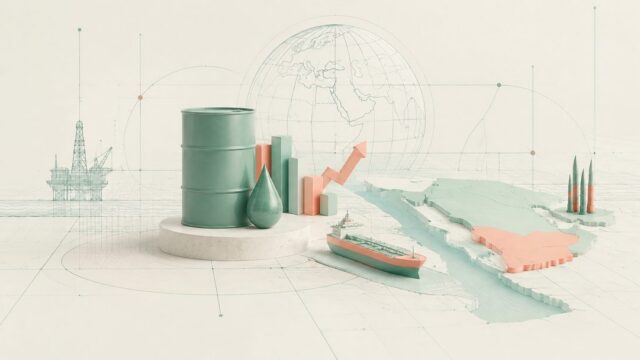
US-Iran Standoff Enters ‘Decisive Week’ as Brent Holds Above $100
TREE NEWS reports: The confrontation between Washington and Tehran is entering a critical new phase. With negotiations deadlocked and military deployments accelerating, President Trump has issued a series of escalating ultimatums while Iran warns of a “more devastating” retaliation if attacked — even as it insists the diplomatic door remains open.
Iranian Foreign Minister Abbas Araghchi said Iran remains willing to pursue a “just and dignified” solution through diplomacy, but vowed a response “more destructive than ever” should military action resume. A Foreign Ministry spokesman said the latest US proposal delivered via Qatar was “largely consistent with previous positions,” focused mainly on nuclear issues, while Tehran’s immediate priority is the Strait of Hormuz. Trump told reporters over the weekend: “On Iran, I will make a decision. Either the easy way or the hard way.” He offered no timetable, adding only: “You’ll see.”
Military Build-Up Accelerates
The USS Theodore Roosevelt carrier strike group has departed San Diego and the Makin Island amphibious ready group has also set sail, together carrying more than 7,000 sailors and roughly 2,000 Marines, expected to reach the Middle East by late October. That would give the US three carrier strike groups near Iran — a concentration unseen since the opening phase of the 2003 Iraq War. Vice President Vance, Secretary of State Rubio, Defense Secretary Hegseth, special envoy Witkoff, CIA Director Ratcliffe and Joint Chiefs Chairman Gen. Caine reportedly gathered at Camp David for a secret meeting covering both Iran and Yemen’s Houthis.
Second Energy Chokepoint at Risk
The Houthis said they struck Saudi Aramco targets in Riyadh with ballistic missiles and drones in retaliation for Saudi airstrikes on Sanaa. Saudi Arabia is reportedly preparing a large-scale military operation against the Houthis aimed at coastal areas controlling the Bab el-Mandeb Strait — the key alternative route for Saudi crude exports bypassing Hormuz. Iran’s parliament speaker and chief negotiator, Mohammad Baqer Qalibaf, said the Strait of Hormuz will not reopen unless seven Iranian conditions are met, including lifting the naval blockade, returning frozen assets, removing oil sanctions and withdrawing US forces near Iran’s borders. Trump has rejected that framework as “nowhere near enough.”
Why Oil Is Still Above $100
Goldman Sachs strategist Thomas Evans estimates the futures-spot spread at roughly $20–25 per barrel, arguing the market is still pricing a substantial risk premium even as near-term supply has recovered. Global oil inventories have fallen by more than 400 million barrels since March, leaving about 4.3 billion barrels at a five-year low. Tanker rates on the Persian Gulf-to-China route have topped $1.2 million per day, and at least four tanker attacks have occurred in waters off southern Oman since last Thursday.
Bank of America raised its H2 2026 Brent forecast to $95 from $83, with a scenario map: a deal (low probability) would bring Brent to $83; sporadic conflict (base case) $95; renewed intensive warfare $120; and attacks on energy infrastructure a tail risk of $150 or higher. Brent near $103 sits precisely between the “sporadic” and “intensive” scenarios.
Key Takeaways for Investors
- Energy is the primary expression: With inventories at five-year lows and a $20–25 risk premium embedded, oil remains asymmetrically skewed to the upside; a Hormuz disruption could trigger a sharp spike.
- Watch six catalysts this week: Trump’s decision, Iran’s reply via Qatar, Yemen’s battlefield, tanker attacks near Oman, Iran’s domestic pressures (rial at 2.7 million per dollar, inflation near 90%), and macro cross-currents including FOMC minutes and Treasury auctions.
- Macro linkages matter: Goldman notes oil’s correlation with rates is unusually high, so the FOMC minutes and 10- and 30-year auctions could transmit directly into crude.
- Defensive positioning: Elevated geopolitical risk supports energy equities, gold and volatility hedges, while pressuring rate-sensitive and cyclical assets if the conflict escalates.