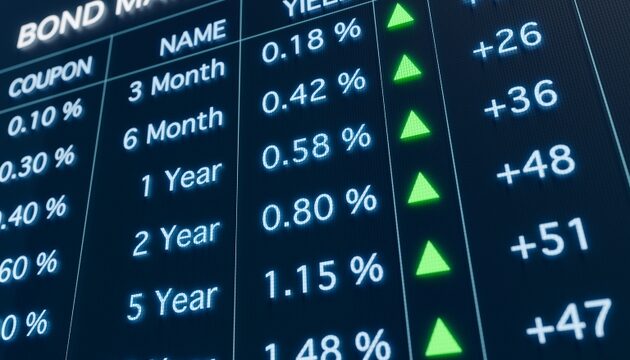
Wall Street Veteran Sees Echoes of 1987 as Bonds Deliver ‘Equity-Like Returns’
TREE NEWS reports: A closely watched market signal that preceded the 1987 stock market crash is flashing again. The warning comes from an unexpected place: the bond market. McDonald notes that bonds are beginning to deliver “equity-like returns,” a phenomenon that closely mirrors the summer of 1987 — just months before Black Monday wiped nearly 23% off the Dow Jones Industrial Average in a single session.
The dynamic is straightforward but unsettling for stock investors. When fixed-income assets start producing returns comparable to equities, the risk-reward calculus that has driven capital into stocks for years begins to shift. Why take on equity volatility when bonds offer similar yields with lower risk? That question, if it spreads through institutional portfolios, could trigger the kind of cascading selling pressure that defined October 19, 1987.
Why This Matters Now
The comparison to 1987 is not merely nostalgic. In the months leading up to Black Monday, Treasury yields rose sharply as bond prices fell, creating attractive entry points for fixed-income investors. Simultaneously, equity valuations had become stretched following a multi-year bull run. When bonds began offering competitive returns, the marginal buyer of stocks disappeared — and the market’s fragile equilibrium collapsed.
Today’s setup shares uncomfortable parallels. Equity markets have rallied hard on the back of the artificial intelligence boom, with concentration in a handful of mega-cap names reaching historic extremes. Meanwhile, Treasury yields have climbed as the Federal Reserve maintains a higher-for-longer posture, and credit spreads have begun to widen subtly. If bonds continue to offer equity-like returns, the rotation out of stocks could accelerate.
Market Implications Across Asset Classes
- Stocks: The most immediate risk is a valuation compression in high-multiple growth names. If the risk-free rate becomes a genuine competitor for capital, the discounted cash flow models that justify today’s sky-high tech valuations break down. Defensive sectors — utilities, consumer staples, healthcare — could outperform as investors rotate toward safety.
- Bonds: Ironically, the very asset class sending the warning signal could be the beneficiary. Increased demand for fixed income would push prices higher and yields lower, potentially creating a feedback loop that stabilizes the bond market while destabilizing equities.
- Crypto: Digital assets have increasingly traded as high-beta risk proxies. A rotation out of equities would likely hit crypto harder, particularly altcoins and speculative tokens. Bitcoin could find some support as a liquidity hedge, but in a genuine risk-off event, correlations tend to converge toward one.
- Commodities: Gold would likely benefit as a safe-haven asset. Industrial metals could suffer if equity weakness signals broader economic slowdown. Oil sits in a nuanced position — supply constraints could offset demand fears, but a sharp growth scare would likely drag crude lower.
- Currencies: The U.S. dollar could strengthen initially as global capital seeks safety, but if the Fed is forced to cut rates aggressively in response to market turmoil, that strength could reverse quickly. The Japanese yen, a traditional funding currency, would likely appreciate in a risk-off scenario.
What Investors Should Watch
The key variable is not whether bonds are offering equity-like returns today, but whether that trend persists. A single month of competitive bond yields is noise; a sustained shift in the risk-reward landscape is a signal. Investors should monitor the yield curve, credit spreads, and — critically — fund flow data. If institutional money begins rotating from equities to fixed income at scale, the 1987 parallel becomes far more than an academic curiosity.
McDonald’s warning is not a prediction of an imminent crash. It is a reminder that markets are reflexive systems where the composition of returns across asset classes shapes investor behavior, which in turn shapes returns. When that feedback loop turns negative, the adjustment can be violent and fast.
Key Takeaways
- Bonds delivering equity-like returns historically preceded the 1987 crash — the signal is back.
- Equity valuations, particularly in AI-driven mega-caps, are vulnerable to a rotation toward fixed income.
- Defensive sectors, gold, and the yen could benefit in a risk-off scenario; crypto and high-multiple tech face the most downside.
- Watch fund flows and credit spreads for confirmation that this is more than a temporary blip.