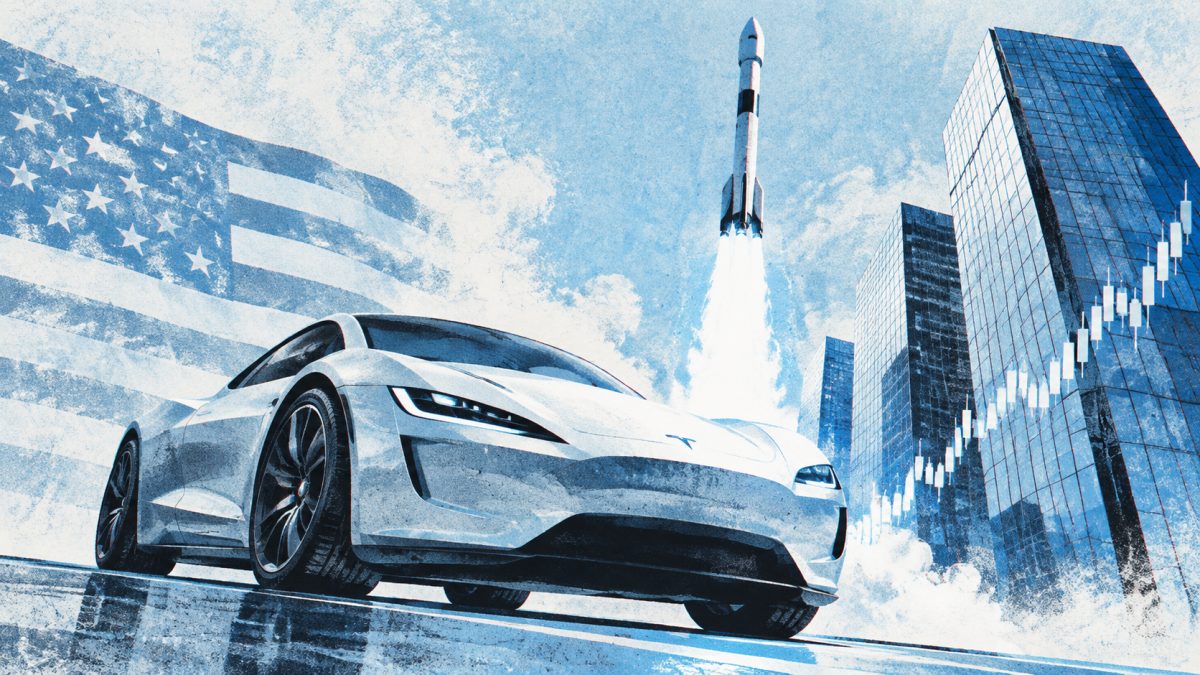
Tesla Roadster Showcases SpaceX Technology, Morgan Stanley Sees Massive Upside
TREE NEWS reports: The recent Tesla Roadster unveiling in Texas was more than just a showcase of a flying car—it was a demonstration of SpaceX’s technological prowess. Morgan Stanley, in a new report, highlights the deepening collaboration between Tesla and SpaceX, reiterating an Overweight rating on SpaceX with a $300 price target, implying over 100% upside from the current ~$148.62 level.
Roadster’s BOM: A SpaceX Story
The majority of the Roadster’s bill of materials (BOM) value derives from SpaceX, signaling a level of technology integration far beyond market expectations. The key feature is the electric-powered cold gas thruster, a technology with potential applications beyond automotive, including defense. Analyst Adam Jonas likens this to a “Kitty Hawk moment,” suggesting the market may be underestimating the historical significance of this technology.
Additionally, SpaceX’s surprise announcement of its Q3 earnings date, with only two working days’ notice, caught Morgan Stanley’s attention. Jonas notes he has never seen such a move, hinting at potentially significant disclosures ahead.
AI Computing: $27 per GW of Stock Value
Morgan Stanley provides a clear valuation framework for SpaceX’s enterprise AI business. Under assumptions of $50 per watt, 70% incremental margins, and 10x EBITDA multiple, each additional GW of owned computing capacity could theoretically add about $27 to SpaceX’s stock price, or roughly 18% of the current price. The firm currently forecasts 4.9 GW of AI computing for FY2027, while the company targets “close to 10 GW.” If achieved, this would imply substantial upside beyond the base case.
The $300 target is derived from a sum-of-the-parts (SOTP) valuation: enterprise AI contributes $165, connectivity (mainly Starlink) $118, space $8, and X & Grok $8. The valuation uses 2040 as the forecast endpoint, discounted to June 30, 2027, with an 11.2% WACC and a 50% execution risk discount applied to enterprise AI.
Fundamental Momentum and Catalysts
Morgan Stanley lists several potential upside catalysts: accelerated Starship reusability, faster Starlink capacity growth, expansion of enterprise direct sales and cloud customers, accelerating Cursor ARR, and reductions in AI infrastructure build costs and power-up times. Downside risks include slower Starship reuse, weaker Starlink user growth, poor enterprise AI monetization, rising capex per unit of computing, longer power-up cycles, increased financing needs leading to dilution, and regulatory delays.
Since initiating coverage in July with an Overweight rating and $300 target, Morgan Stanley has consistently maintained a bullish stance on SpaceX’s long-term investment case, publishing deep-dive reports on Starship test flights, the Louisiana launch complex, and AI strategy.
Market Implications
While SpaceX is privately held, the report has implications for Tesla and the broader tech ecosystem. The deepening ties between Tesla and SpaceX could reshape investor perceptions of both companies, potentially unlocking value for Tesla shareholders who may not fully appreciate the SpaceX technology embedded in its products. For the space and satellite communications sector, SpaceX’s momentum—particularly Starlink’s growth and Starship’s progress—could pressure competitors and reshape industry dynamics.
In the AI infrastructure space, SpaceX’s ambitious computing buildout (targeting 10 GW) would represent a significant addition to global AI capacity, with implications for energy demand, semiconductor supply chains, and cloud computing competition. The valuation framework provided by Morgan Stanley offers a template for assessing other AI infrastructure plays.
Key Takeaways for Investors
- SpaceX’s technology is permeating Tesla products, with the Roadster’s BOM largely sourced from SpaceX, indicating deeper collaboration and potential for future synergies.
- Enterprise AI is the largest value driver in Morgan Stanley’s SOTP, with each GW of computing adding ~$27 to the stock. The company’s 10 GW target vs. the 4.9 GW forecast implies significant upside.
- Fundamental momentum is strong across space, connectivity, and AI, with multiple upside catalysts and manageable downside risks.
- Valuation appears attractive, with the stock trading at a low multiple for its AI business compared to neocloud peers, and lockup expirations not weighing on the stock as expected.
- Watch for potential disclosures at SpaceX’s Q3 earnings, given the unusual short notice.